Your Ultimate Competition Prep Guide
The countdown is on.
It’s competition season and you’re ready to dive into a new experience to take your parkour journey to the next level.
You've moved past simple training and into the dedicated & focused phase of preparation. Maximizing your performance, dialing in your nutrition, and ensuring you peak at the right moment.
This guide works for both the independent athlete, coaches and parents learning how to support their young, or new-to-this-realm athlete.
Here is a 3-month breakdown of how to structure your training, diet, and recovery:
—
Month 1: Building a Solid Base
The first month is about building up your foundation and increasing volume. This is when you should be pushing your body the hardest in terms of workload.
💪 Training Focus: Volume and Variety
Identify Weaknesses (weeks 1-2): Spend time targeting your athlete’s known deficiencies. If mobility & flexibility is lagging, dedicate daily sessions to improve it. If a specific movement is problematic, drill it until it becomes second nature.
Increase Training Volume (weeks 1-2): Aim to increase the total amount of work your athlete does—more sets, more reps, or longer sessions. This is their chance to build resilience and endurance.
Introduce Specific Drills (weeks 3-4): Start incorporating competition-specific drills or simulated performance scenarios. For example, if your athlete is competing in the “Skill Event,” you will want to develop a routine of rail balancing as this skill is commonly used to break ties.
🍽️ Nutrition Focus: Fueling the Workload
Consistent Hydration: Focus intensely on water intake. Dehydration severely impacts performance and recovery.
Balanced Macros: Maintain a balanced intake of protein, fats, and carbohydrates to support the high volume of training. Do not restrict calories yet; your body needs the energy.
Meal Planning: Develop a consistent meal plan now. This ensures you are hitting your nutrient goals and avoids "stress eating" later.
—
Month 2: Intensity and Precision
This is where the intensity increases, and you begin to refine your athlete’s approach. Volume should start to decrease slightly as you transition to heavier, more demanding work.
💪 Training Focus: Intensity and Technique
Elevate Intensity: Focus on quality over quantity. Lift heavier weights, run faster intervals, or increase the difficulty of your techniques or drills. Your goal is to train at or above competition pace.
Injury Management: With heavier loads, technique is paramount to prevent injury. Focus training techniques that prevent injury.
Contingencies: Build confidence in things not going to plan. Your athlete’s routine, an injury, travel, food etc.
Practice Transition/Rest: If your athlete’s competition involves multiple events or rounds, practice your rest and recovery protocols. What will you eat? What movements will you use to stay warm?
🍽️ Nutrition Focus: Fine-Tuning and Diet Checks
Experiment with Pre- and Post-Workout Fuel: Test different foods and supplements to find what gives your athlete the best energy for performance and the fastest recovery. Document their results in a tracking spreadsheet, or create a physical or digital log/note.
Consult a Professional: If you haven't already, consult a sports nutritionist or dietitian if this resource is available to you.
—
Month 3: Peaking and Tapering
The final month is all about getting to the start line healthy, fresh, and confident. The hardest work is done; now, it’s time to recover.
💪 Training Focus: Taper, Rest, and Mental Prep
The Taper (Weeks 9-10): Gradually reduce your athlete’s training volume (sets and reps) while maintaining or slightly increasing the intensity (weight, height or speed). The goal is to shed fatigue while keeping your muscle strength primed.
Bare bones (Weeks 11-12): Training only the essentials. Injury management is paramount. This is where you find out where you are at. Categorize techniques for yourself:
🟢 If your athlete can do the technique without warming up, it's low risk.
🟡 If your athlete needs a warm up, it's a medium risk.
🔴 If it takes a spot, a mat, or more than 5 tries, it's a high risk.
Then decide the appropriate reps for the risk level.
Mental Rehearsal: Have your athlete spend time visualizing their performance at the venue. If they can't visit the facility, then look up pictures or videos of previous competitions. Practice positive self-talk and develop a plan for managing nervousness.
Final Gear Check: Ensure all your competition equipment (shoes, uniform, etc.) is ready.
🍽️ Nutrition Focus: Readiness
No New Foods: Absolutely do not introduce any new foods or supplements. Stick to what you know works.
Plan Competition Day Meals: Map out every single meal and snack for the day of the event to eliminate stress.
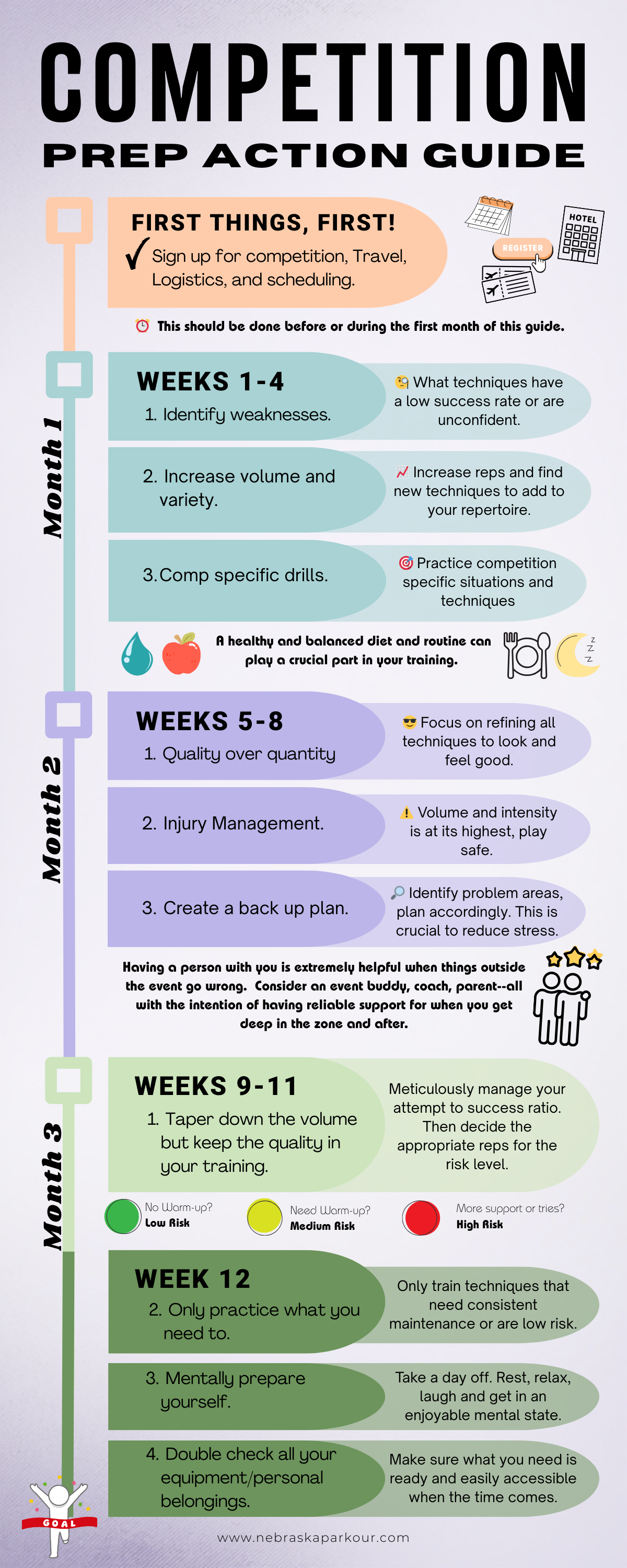
Grab and save this free infographic above to have handy!
Want or need more support?
Consider adding more classes to your membership, schedule private lessons with a coach, or sign-up for the competition workshop on March 28, 2026!
Our professional coaches can help you achieve your goals.
Upcoming Competition Events
USPK Regional Qualifier on April 18-19, 2026
at Nebraska Parkour Gym
Sign-up Now
Competition Workshop w/ Coach Quinlan on March 28, 2026
Sign-up Now