
Updates to Ranking System & Evaluations
We’re making changes to our ranking system and proactively evaluating students on a specific cadence. Our ranking system has been posted on our walls and partially used internally by coaches and staff members to determine upcoming and immediate students between Level I and Level II classes. However, our upcoming changes are intended to improve student, family, and even coach experiences throughout our program.
Previous Ranking system Usage
Designing an effective ranking system is not an easy task. When we first designed our ranking system, Level II classes did not exist, and we were not familiar with student behaviors, predictable progress, validity of criteria, and pragmatics of testing criteria. However, we had a baseline and wireframe for what we envisioned. While the first version had many flaws as a draft, it was helpful for us to discover what was working and what was not working over the years.
challenges
There were many challenges previously (and even now) when creating and updating our ranking system. Here are just a few of the questions we had to ask:
How do you evaluate parkour when it is non-structured and non-competitive by nature?
What movements should be taught and what movements should be tested, and at what part of the journey should these happen?
Do we use formal or informal testing?
How do we ensure students have the physical strength to achieve the next rank?
Should testing criteria be built into competition formats (speed, skill, style)? If so, what individual movements should be tested and how do you evaluate that?
Should we only test specific movements or are there concepts, knowledge, social skills, and milestones that need to be achieved?
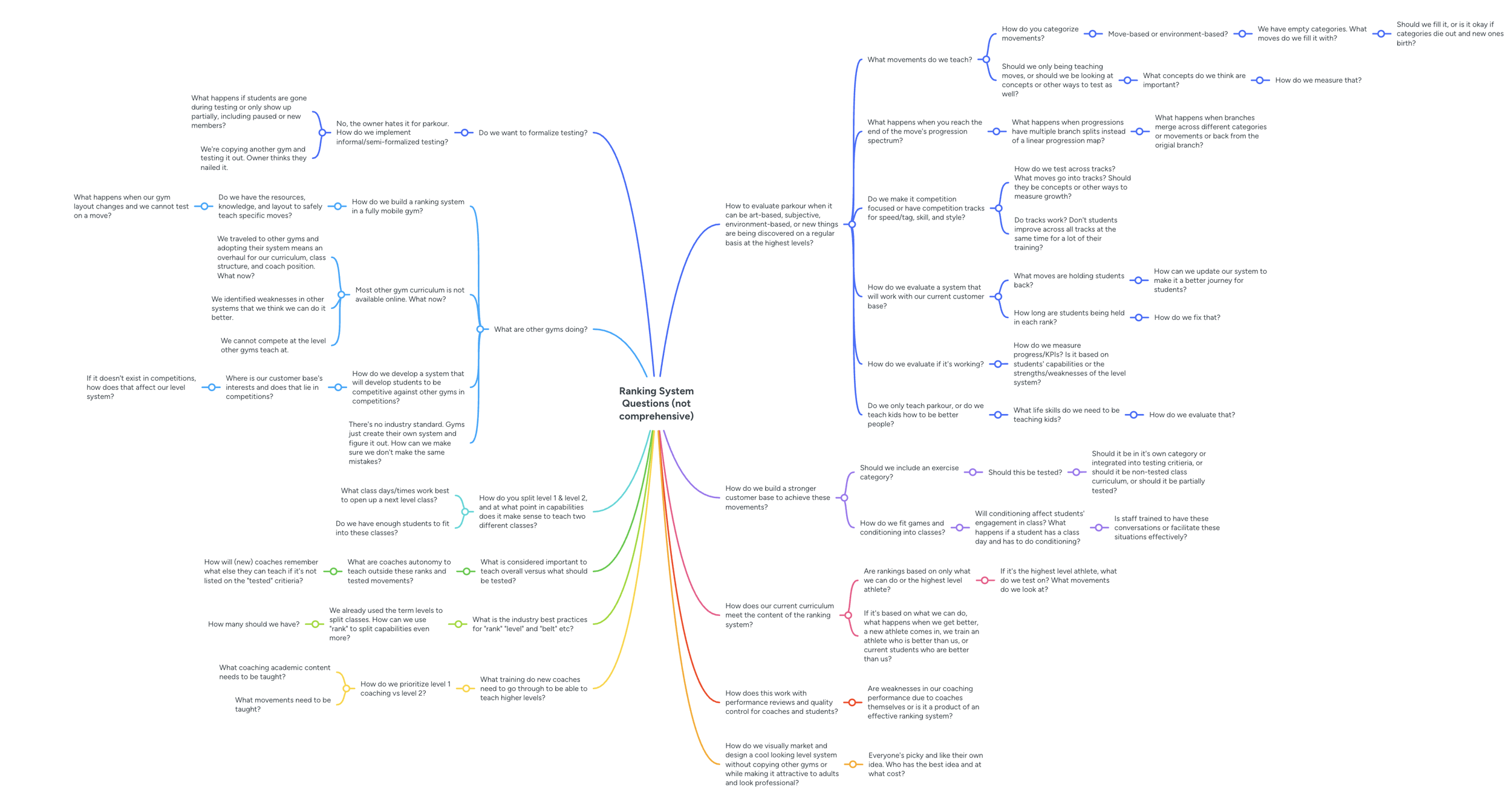
See a larger list of challenges when designing a ranking system.
Historically, we had grouped level 1/2 and added 2/3 classes as students became higher performing. Yet, we had to add this structure without interfering with the days/times students were in class since many are reliant on the schedule. At the same time, three levels were too wide to measure student progress, so we adopted a ranking system to split up student capabilities more accurately without interfering with our current class schedule.
Levels are used in our class management platform to determine who is in a beginner class and who is in an advanced class. Ranks are used to evaluate students within each level. When they are used together, we designed it as follows:
Level I Classes: Rank 1-4
Level II Classes: Rank 5-8
Level III Classes: Rank 9-10
Rank 1
Rank 2
Rank 3

Rank 4
Rank 5
Rank 6
Rank 7
Rank 8
Rank 9
Rank 10
current status/progress
We have finished our second version of ranks 1-4. We are going to continue working to finish revising and finalizing the remaining ranks over the next few weeks. Over the following months, we will begin making small iterations within the system for improvements.
Additionally, we know students and families want to know their progress and information dissemination has been an issue. Families did not what they could work on at home and how close they are to an advanced class.
the plan and what you can expect
Semi-formal testing a few times a year. Unlike formalized testing where it is a pass or fail over one or limited attempts, there will be a 4-week testing period every 4-6 months where students must show competency in the required testing criteria. The first evaluation period will begin in June, 2026.
Instead of levels, classes are now denoted as beginner, intermediate, and advanced: BEG, INT/ADV.
Ranks are now levels: Level 1-10, Level 1 is Groundwork.
Level cards used for evaluations and for students to take home and measure their progress. Upon completion of a level, they will receive a signed level card from their primary coach(es).
Individual student levels listed on student profiles. When you log into our class management platform, student profiles will have their previously testing rank on their profile.
Classes organized with similar levels. With beginner classes covering four levels, we will begin moving students around to make it easier for coaches to manage students of similar levels and capabilities. This will make it easier for coaches to improve the quality of their classes and level students up better/more quickly.
We are hoping these changes will catalyze progress, give students motivational milestones, and keep families informed.
Leveling up can take between a few months to a year depending on students. They should be focused on their progress, enjoying classes, being part of the community, and not tying their identity to their level.
Results: • We require a 100% completion rate. See #3 below for details. • We identified a few weaknesses in our current classes that need to be changed.
1) Paper cards were attrocious and had flaws. We knew that going into it. However, we found a way to to hook up an API/automation with a few softwares that will give you access to our level system online.

  2. Curriculum changes will reflect new content withholding students from leveling up.

  3) If you or your student levels up between evaluation periods, we will promote you immediately without having to wait. Evaluation periods are ideal for mass testing. We had many students who were held back by 1-2 movements. Once those are achieved, they will immediately rank up.

  4) Intermediate classes now consist of anyone who has completed level 3. This may change in the future.

  5) Classes will be organized by levels as best as possible due to family schedules and levels.

  6) Student levels are updated in our class management platform in the student last name.
  E.g. [John Doe - Lvl 1]

  7) Intermediate evaluation critieria is still being developed.
</p>